


5 Things We Learned This Week - 3/8/2026
March 8, 2026
The S&P 500 fell 2.0% this week. The Bloomberg Aggregate Bond Index fell 1.0%, while Gold declined 2.1% and Bitcoin rallied 3.8%.
January PPI surprised to the upside, with wholesale prices rising faster than expected, underscoring sticky pipeline inflation. ISM manufacturing stayed in expansion territory with a bump higher in New Orders. The February jobs report disappointed, showing a decline of 92,000 jobs and an uptick in unemployment to 4.4%. Retail sales softened, falling 0.2%, hinting that the consumer is beginning to wobble.

The Iran War Changes The Macro Outlook Considerably

In the words of boxing legend Mike Tyson, "Everyone has a plan until they get punched in the mouth."
Entering this year, Silverlight's macro forecast was for a fire and ice scenario to play out. That is, we expected a resilient economy would receive additional stimulus going into the midterm elections, which would eventually lead to uncomfortable inflation and an economic slowdown. Things changed this week in a way that materially accelerates the inflation risk. As of this writing, U.S. crude oil prices are trading at $104, up about 90% since the December low. Middle East tensions have escalated as traffic through the Strait of Hormuz is disrupted.
Gulf producers have begun cutting output as the effective closure of the Strait of Hormuz chokes off export routes. Qatar has shut most LNG production, while Iraq and Kuwait have started scaling back oil output as storage fills and shipping stalls. The UAE and Saudi Arabia are also trimming production, with Abu Dhabi managing offshore flows and Saudi Aramco shutting its largest refinery at Ras Tanura after a drone strike. These are not coordinated OPEC policy cuts but forced curtailments driven by infrastructure attacks, tanker shortages, and blocked sea lanes, tightening global supply. Once wells and facilities are shut in, pressure, fluids, and equipment can deteriorate, causing mechanical damage and even partial reservoir loss that require costly, time‑consuming repairs to reverse. In practice, that means restarting production often isn’t just “flipping a switch.” It requires mobilizing rigs, crews, and specialized workovers to safely restore flow, which can take months.
According to analysis by Goldman Sachs, if oil prices rise $10 and stay elevated for three months, U.S. CPI inflation would likely rise from 2.4% to 3%. Oil is embedded in gasoline, diesel, jet fuel, plastics, fertilizers, and shipping, so it touches everything from commuting and flights to groceries and goods on shelves, making it a heavy weight in headline CPI. The spike in crude oil raises the risk the Fed will delay or scale back planned rate cuts to avoid reigniting price pressures.
In the last 5 Things, we said that if the U.S. attacked Iran and the S&P 500 closed under key technical levels, we would take defensive action. All three variables came to fruition last week, so we raised cash and implemented strategic short hedges to protect clients' year-to-date gains. We maintain a healthy overweight to the energy sector. Nobody has a crystal ball to know precisely where the Iran War goes from here. If President Trump becomes uncomfortable with rising oil prices, perhaps he changes course in some way? We will continue to monitor the situation as it evolves and update our views accordingly.
Recent volatility stimulated a preference shift in the stock market away from growth and high beta equities toward more defensive, blue-chip securities. Amid that rotation, however, the overall trend in the S&P 500 has managed to remain above key support levels. The bears had a great opportunity to take firm control of the market in recent weeks, but have thus far failed to do so. Time appears to be running out.
The systematic positioning setup isn't great, but it's far from dire. Volatility control funds are now well off the peak exposure levels from last year, which leaves room for upside accumulation if stocks regain upward momentum. CTA positioning is also off peak levels and could go either way from here.
Investor sentiment is another technical factor we monitor closely. The CNN Fear Greed Index currently resides in the "Fear" zone, which is usually a contrarian bullish signal. Widespread fear is bullish because it means there's a lot of room for attitudes about the market to improve, and that's what stimulates new buyers. While different sentiment surveys are always somewhat mixed, we think there are catalysts for sentiment to improve in the coming weeks. Corporate earnings remain strong, and this week's tariff news is probably going to nudge animal spirits higher (see story #2).
The main risk we will monitor in the coming weeks relates to the military buildup in the Middle East. If the US attacks Iran and oil prices spike considerably, we will take defensive action and reconsider our tactical plan. That said, until we see definitive bearish confirmation signals (i.e. a break below 6,700 on S&P 500), we will presume the bulls remain in charge.

Is The Block Layoff Foreshadowing a Black Swan?

Given the sharp rise in crude oil prices, input cost pressure is likely going to make more companies think about ways to cut costs in the coming months. Labor will probably be one of the principal levers many CFOs turn to.
A few weeks ago, Block, Inc. announced it would eliminate more than 4,000 jobs—nearly half its workforce—as part of an aggressive AI-driven restructuring. The headlines sounded grim. Yet in the after-hours market, shares surged nearly 20%, as investors applauded what they interpreted as a decisive pivot toward automation.
CEO Jack Dorsey has never been afraid to run at the front of the pack. From pioneering mobile payments to championing crypto infrastructure, he tends to lean into disruption rather than hedge against it. Now he’s making a bold bet that a leaner, AI-augmented organization can produce higher margins and faster innovation. If Dorsey is right, this won’t be an isolated story. It will become a template.
Artificial intelligence may very well become the productivity catalyst of our generation. Just as the internet reshaped commerce in the late 1990s, AI could streamline operations, compress research cycles, personalize services at scale, and optimize capital allocation across industries. If productivity accelerates meaningfully, equity valuations may follow. But seasoned investors know every boom carries embedded fragilities, which is why it's important to always beware of Black Swans.
In his seminal book, The Black Swan, Nassim Nicholas Taleb describes a 'Black Swan' as an event that meets three criteria:
- It is highly improbable.
- It carries massive impact.
- After it happens, people rationalize it was predictable all along.
The metaphor originates from an old European assumption: all swans were white—until black swans were discovered in Australia. In markets, Black Swans are the moments that expose hidden assumptions. Like when subprime mortgages suddenly appeared shaky and ignited the 2008 financial crisis.
What would an AI-era Black Swan look like? It won't be an “AI improves productivity” type of story. That’s the visible narrative. A proper Black Swan would be a second-order effect—something nonlinear. Something that is hard to fathom ahead of time but easy to see in hindsight.
For example, what if rapid AI displacement triggers a spike in unemployment? If that happens, consumer spending would probably crater, and social and political instability would likely surge. Given current macro dynamics, the Block story feels like it may be an important turning point. One indicator we will be watching closely to monitor the labor market going forward is initial jobless claims. The most recent reading was 213,000, which is relatively benign.

The Dollar Is Testing a Critical Level
Think of the U.S. dollar as the balance sheet of the global economy. When it tightens, the world tightens with it.
That’s why the latest move in the dollar deserves attention. In mid-February, the greenback registered a weekly TD Combo buy signal. Since then, momentum has carried the index higher, producing a higher high and higher low on the daily chart. Now the DXY sits directly beneath daily TDST resistance at 99.39. If that level breaks, it could shape the next phase of global asset leadership.
The dollar is the world’s cost of capital. Trillions of dollars in debt issued outside the United States are denominated in USD. When the dollar rises, servicing that debt becomes more expensive. Borrowers must generate more local currency to repay the same obligation. That shift acts like a tightening valve on global liquidity. Emerging markets feel the pressure first. Governments and corporations divert cash toward interest payments instead of investment, slowing economic momentum and raising recession risk.
The dollar also quietly shapes investment flows. For U.S. investors, a stronger greenback erodes returns from foreign equities as local currencies depreciate. At the same time, it reinforces the appeal of dollar-denominated assets in global carry trades—where investors borrow in low-yield currencies and invest where returns are higher. The result is a feedback loop: stronger dollar, stronger relative performance for U.S. assets.
But currencies are ultimately about confidence, and confidence can change quickly. Rising geopolitical tensions in the Gulf introduce a different variable into the equation. Iran’s missile strikes near Dubai highlight the fragility of a region that has long marketed itself as a haven of stability. For years, the UAE and Saudi Arabia attracted global capital, expats, and technology talent precisely because they offered predictability in an uncertain world. That “certainty premium” matters more than it appears. If the perception of stability erodes, capital flows can reverse. Sovereign wealth funds that once recycled petrodollars into Western financial markets may redirect liquidity closer to home. Less recycling into U.S. debt markets would mean higher borrowing costs and growing pressure on the financial architecture that underpins the dollar system.
This is where geopolitics meets monetary plumbing. A destabilized Gulf could strain currency pegs, accelerate alternative settlement systems among BRICS nations, and gradually chip away at the petrodollar framework that has supported global dollar demand for decades. None of this will be decided overnight. But markets often give early signals before narratives catch up. A dollar breakout would reinforce the story of tightening global liquidity and continued U.S. asset leadership. A failure, however, might suggest that deeper shifts are underway beneath the surface of the global financial system.

Exxon Mobile Thesis To Own
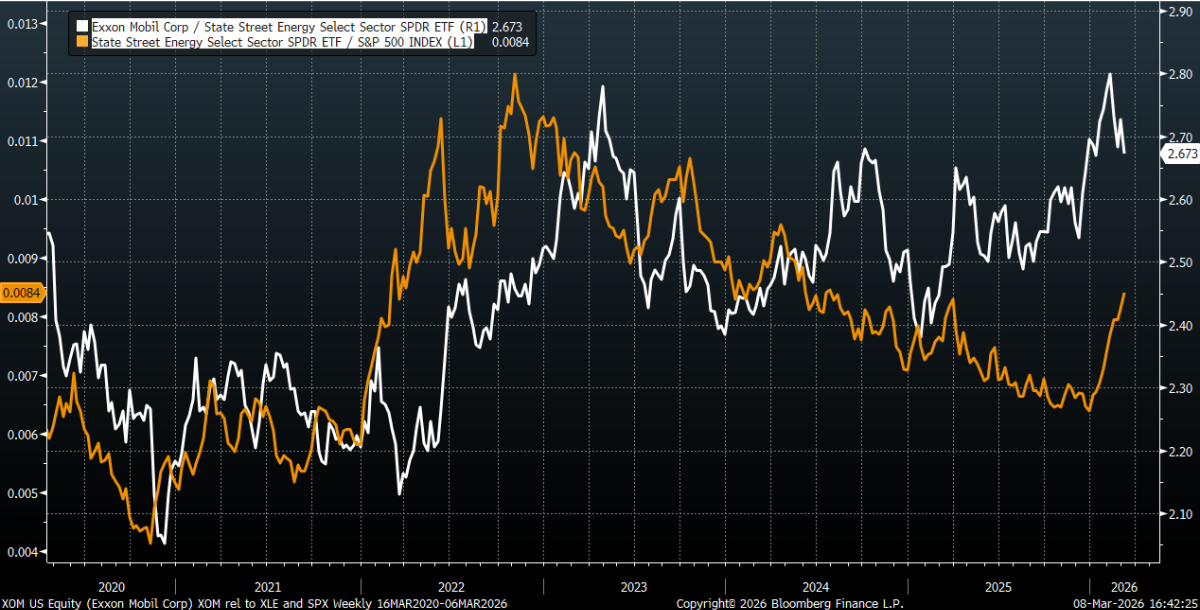
Exxon Mobil (XOM) traces its roots back to 1870, when John D. Rockefeller founded Standard Oil, which evolved into today's energy titan. Now, with a market cap exceeding $630 billion, XOM stands as the most valuable energy company in the U.S., outpacing peers like Chevron and ConocoPhillips. As the largest holding in the Energy Select Sector SPDR ETF (XLE) at a 23.6% weight, XOM benefits from the ETF-driven nature of modern markets. When investors rotate into energy and XLE outperforms the S&P 500, XOM typically amplifies those gains, as the above chart illustrates. The white line is XOM's relative performance compared to XLE, whereas the orange line depicts XLE's relative performance compared to the S&P 500.
XOM operates across three core segments: upstream exploration and production, focused on high-return assets like the Permian Basin and Guyana; downstream refining and marketing; and chemical products. This integrated model delivers above-average quality traits, including exemplary capital allocation and a narrow economic moat from cost efficiencies, physical integration (80% of refining tied to chemicals), and flexibility in short-cycle investments. These attributes enable robust earnings growth while maintaining discipline.
Unlike many oil majors burdened by heavy Middle East exposure, XOM is uniquely positioned to benefit amid Iran's supply disruptions. With minimal regional assets, XOM's growth is anchored in the secure Western Hemisphere—Permian Basin and Guyana—free from Persian Gulf transit risks like skyrocketing war premiums and tanker bottlenecks. This allows rapid production ramps to capture surging oil prices, while the Golden Pass LNG terminal's launch enables premium exports if Qatari supplies falter, outpacing entangled competitors like Chevron or BP.
Valuation-wise, XOM trades at a trailing P/E of 22.6, with a shareholder yield (stock buybacks + dividends) of 6.3%. In today's market, XOM appears to be a no-brainer long. It fits Silverlight's Quality at a Discount fundamental criteria, is buoyed by rising XLE flows, and should provide a timely hedge against soaring oil prices from the Iran war—the world's top macro risk.

Lessons From Man's Best Friend: Living In The Now

Dogs live in a timeless bubble, unbound by the stress of clocks and calendars. While we humans obsess over yesterday's regrets and tomorrow's anxieties, our canine companions live purely in the present.
Dogs don't dwell on that chewed slipper from last week or fret about the vet visit next month. Their time perspective is simple: now is all there is. This evolutionary gift keeps them attuned to immediate sensations—the wag of a tail, the scent on the wind, the joy of a belly rub—without the extra mental clutter that too often distracts us. A dog doesn't care about where oil prices are going, or where the S&P 500 will finish this year. They live for today.
The wellbeing benefits of being immersed in the present moment are profound. Focused engagement with the world facilitates mindfulness, which is scientifically proven to reduce stress hormones while boosting endorphins. Studies show pet ownership correlates with lower blood pressure and improved mental health. When a dog greets us at the door with its tail whipping like a windmill, it's easy to see they are fully immersed. We get a break from our day and feel appreciated in that moment of unconditional love.
To cultivate more presence, you don’t need a retreat in the mountains, or even a dog, necessarily. All you need is a few minutes and the willingness to actively manage your emotional balance sheet the same way you manage your financial one. Here are three ways to cultivate a higher state of wellbeing:
1) Run a “Single-Task Sprint” each day.
For ten minutes, pick one simple activity—walking, making coffee, reviewing a report—and do it with zero mental multi-tasking. No podcasts. No background scrolling. Notice the sounds, textures, even your breathing. Think of it as interval training for your attention.
2) Create “No-Notification Zones.”
During meals, workouts, or your first 30 minutes in the morning, put your phone in another room. Not face down. Not silent. Out of reach. If you wouldn’t let a stranger interrupt your dinner every three minutes, why let your device do it? Protecting your attention is the emotional equivalent of preserving capital.
3) Close the Day with a Two-Column Ledger.
Before bed, draw a simple line down a page. Left side: Assets Added Today (moments of courage, connection, progress). Right side: Liabilities Reduced (stressors eliminated, distractions avoided, excuses challenged). Creating this kind of ledger reframes your life as something you’re actively managing—not passively drifting through. Rover will be proud of you.
This material is not intended to be relied upon as a forecast, research or investment advice. The opinions expressed are as of the date indicated and may change as subsequent conditions vary. The information and opinions contained in this post are derived from proprietary and non-proprietary sources deemed by Silverlight Asset Management LLC to be reliable, are not necessarily all-inclusive and are not guaranteed as to accuracy. As such, no warranty of accuracy or reliability is given and no responsibility arising in any other way for errors and omissions (including responsibility to any person by reason of negligence) is accepted by Silverlight Asset Management LLC, its officers, employees or agents. This post may contain “forward-looking” information that is not purely historical in nature. Such information may include, among other things, projections and forecasts. There is no guarantee that any of these views will come to pass. Reliance upon information in this post is at the sole discretion of the reader.