


5 Things We Learned This Week - 5/24/2025
May 24, 2025
The S&P 500 fell 2.6% this week. The Bloomberg Aggregate Bond Index fell 0.4%, while Gold rose 5.3% and Bitcoin rose 4.4%.
Wall Street faced the most volatile week since early April as investors navigated rising long-term bond yields and economic uncertainty. The bond market wobbled after a weak 20-year bond auction and Moody’s US credit rating downgrade, signaling concerns over fiscal deficits. The US dollar fell 1.8% this week. This explains why gold and bitcoin rallied huge, and international stocks outperformed by rallying 0.8%. The US Leading Economic Index dropped 1.0% in April, its largest decline in over a year.

The Dollar Is A Sell
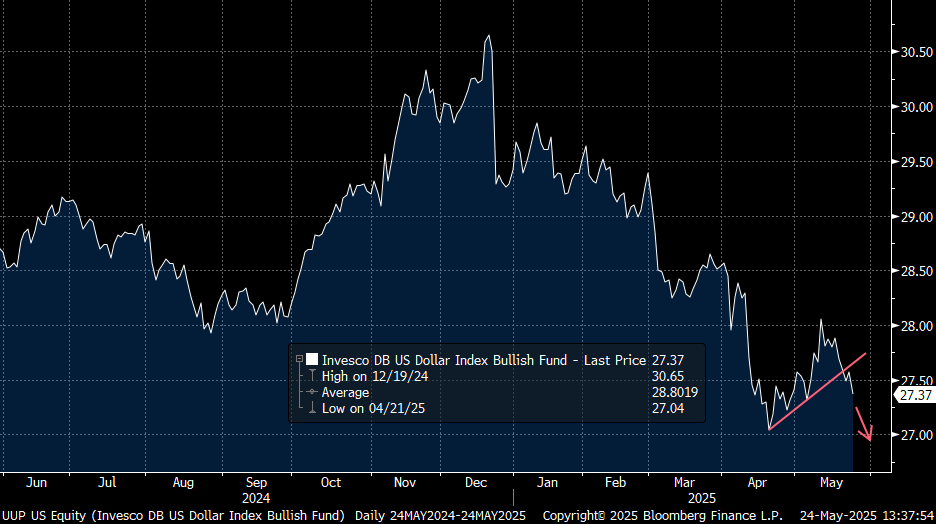
The US dollar just broke an important technical support line. Watch out below.
Mounting fiscal concerns are part of the problem. Moody’s recently downgraded the US credit rating to Aa1, citing excessive debt and persistent deficits. President Trump’s “Big Beautiful Bill” is projected to add trillions to the deficit over the next decade. Rising Treasury yields signal market skepticism about fiscal sustainability. What was the point of DOGE if the government is going to just continue its out of control spending habit? If someone is trying to lose weight, they won't get anywhere by quitting Twinkies and pivoting to Ho Hos. The government has to cut spending to cut the deficit, and clearly that is not a true priority in Washington.
In a weak dollar environment, investors can pivot to assets that historically thrive. International investments, particularly in emerging markets, benefit from currency tailwinds. Gold is up 27% this year and offers a hedge against dollar depreciation. Bitcoin, increasingly viewed as digital gold, also offers a layer of portfolio resilience. As deficits swell and the dollar weakens, diversifying into hard money assets like these is a sound strategy to protect purchasing power.

Bitcoin Continues To Prove The Haters Wrong
Bitcoin has once again defied skeptics, rallying this week amid a turbulent market while traditional assets faltered. Year-to-date, Bitcoin is up 17% while the S&P 500 is down 1%.
In prior years, Bitcoin mostly moved in sync with the Nasdaq, reinforcing its reputation as a speculative tech-driven asset. But recent price action tells a different story—while stocks and bonds sold off on fiscal uncertainty, Bitcoin has remained sturdy. Is it finally cementing its role as a decentralized alternative? This shift comes as institutional interest strengthens, with major ETFs capturing billions in inflows. Investors weary of policy risks and inflation concerns are turning to Bitcoin for diversification. Meanwhile, treasury bonds have struggled under debt and policy worries,.
Looking ahead, the adoption of regulated digital assets, growing institutional buy-in, and concerns over sovereign debt could fuel further upside. While Bitcoin remains volatile, its ability to decouple from traditional markets suggests a maturing asset—one that even skeptics may soon consider indispensable.

Could Japan's Bond Market Trigger a Global Financial Market Meltdown?

Societe Generale strategist Albert Edwards warns that surging Japanese government bond (JGB) yields could spark a "global financial market Armageddon." His concerns stem from the Bank of Japan (BOJ) scaling back bond market support, driving long-term yields to multi-decade highs. This threatens the yen carry trade, where investors borrow low-cost yen to invest in higher-yielding foreign assets like US Treasuries and equities. Edwards argues that a rapid unwinding of this trade could trigger capital flight from US markets, destabilizing stocks and bonds already strained by fiscal deficits.
Why Edwards Might Be Right:
Japan’s bond market is the third-largest globally, and a collapse could ripple through interconnected financial systems.
Foreign investors dominate JGB purchases, and rising yields may prompt repatriation, squeezing liquidity elsewhere.
Similar BOJ policy shifts in 2024 caused a 6% S&P 500 drop.
Counterarguments:
The BOJ could intervene to stabilize yields, as it has during past crises.
U.S. markets face independent pressures (e.g., fiscal deficits), which may overshadow Japan’s impact.
Global central banks might coordinate to prevent systemic contagion.
While Edwards’ warnings highlight real vulnerabilities, the outcome hinges on policymakers’ responses—and whether Japan’s crisis becomes the world’s domino. We will continue to monitor this trend closely going forward.

Google's New AI Tools Are Awesome

Google I/O 2025 was a showcase of AI innovation, with a slew of updates that left the tech world buzzing. The headline acts included Gemini 2.5, which brings lightning-fast, smarter responses and a new “Deep Think” mode for complex reasoning. Creatives will love Imagen 4 for next-gen image generation and Veo 3 for advanced video creation with native audio and realistic animations. AI Mode in Search is a game-changer, offering conversational, multimodal answers and agent-like features that can book appointments or shop for you—all designed to supercharge productivity.
These tools cement Google’s position near the front of the AI race, with Gemini gaining ground on rivals and commercial adoption accelerating. With shares trading at a reasonable valuation and robust growth in cloud and ad sales, Google checks many boxes for GARP investors seeking innovation and value.

Stephen Hawking’s Time Experiment and Slowing Life’s Pace

Time travel on planet earth is possible. In a fascinating experiment inspired by Stephen Hawking, people tested time dilation using cesium atomic clocks. One clock stayed near sea level, while another was taken to a high altitude where Earth’s gravitational pull is weaker. After 24 hours, the clocks were compared, revealing a slight time difference—proving time moves faster at higher altitudes due to general relativity’s effect on spacetime. This experiment, featured in Genius by Stephen Hawking, underscores how gravity warps time.
We can also purposefully slow down our perception of time. According to Psychology Today, this can enhance mindfulness, reduce stress, and increase overall life satisfaction. When you become more present, you absorb more details, making experiences feel richer and more fulfilling. Here are some practical ways to intentionally slow time and enjoy life more:
Practice mindfulness: Engage fully in the present moment by focusing on your senses, surroundings, and emotions.
Seek novelty: New experiences create more vivid memories, making time feel longer and more meaningful.
Limit distractions: Reduce multi-tasking and digital interruptions to deepen your engagement with activities.
Engage in deep breathing: Slow, intentional breathing can help ground you and stretch your perception of time.
Savor anticipation: Looking forward to something—like a planned trip or a special meal—can make time feel richer.
Immerse yourself in nature: Spending time outdoors, observing details like the movement of clouds or the rustling of leaves, can slow your sense of time.
Use music strategically: Slow-paced music can make time feel more expansive, while fast-paced music can speed it up.
This material is not intended to be relied upon as a forecast, research or investment advice. The opinions expressed are as of the date indicated and may change as subsequent conditions vary. The information and opinions contained in this post are derived from proprietary and non-proprietary sources deemed by Silverlight Asset Management LLC to be reliable, are not necessarily all-inclusive and are not guaranteed as to accuracy. As such, no warranty of accuracy or reliability is given and no responsibility arising in any other way for errors and omissions (including responsibility to any person by reason of negligence) is accepted by Silverlight Asset Management LLC, its officers, employees or agents. This post may contain “forward-looking” information that is not purely historical in nature. Such information may include, among other things, projections and forecasts. There is no guarantee that any of these views will come to pass. Reliance upon information in this post is at the sole discretion of the reader.